"I Convinced Myself I Just Had a Velcro Baby": One Mom's Journey from Exhausted to Thriving
Her 6-week-old wouldn't sleep more than an hour — only in her arms. His latch was shallow, his gas was constant, and she had lost hope. Then the scans showed something nobody had looked for.
"I Just Had an Overly Fussy Velcro Baby. This Was Simply Our Reality."
That's what this mom had convinced herself.
Her son was six weeks old. He wouldn't sleep for more than an hour — and only then if he was held. His latch was shallow. He wasn't finishing feeds. He was gassy, uncomfortable, and overtired around the clock. She was exclusively breastfeeding and trying to do everything right, and none of it was working.
She'd tried everything she could think of. And when she walked through our doors for the first time, she was, in her own words, "completely exhausted, overwhelmed, and running on empty."
When Susie told her she truly believed they could help her baby, mom responded cautiously — almost negatively. She wrote about it later in a Google review that stopped us in our tracks:
"I honestly responded pretty cautiously — almost negatively — because at that point I had lost hope. I had convinced myself I just had an overly fussy 'Velcro baby' and that this was simply our reality."
If you've ever felt that way — like fussiness and sleeplessness are just your baby's personality and you need to accept it — this post is for you.
It Wasn't His Personality. It Was His Nervous System.
When we evaluated this little one with our neurologic scans, they told a clear story. Significant tension in his neck and lower back. His tiny body was stuck in stress. The kind of physical stress that, in a six-week-old who can't speak, shows up as relentless fussiness, poor sleep, shallow latch, and a baby who can only settle when held — because being held provides the pressure and warmth that temporarily soothes a nervous system stuck in overdrive.
His mom described the moment she saw the results:
"It all suddenly made so much sense. No wonder he was so fussy — he was so uncomfortable!"
This is what neurologically-based chiropractic care does that nothing else addresses: it looks at the nervous system objectively. Not based on symptoms alone. Not based on gut feeling. Based on data. Neurologic scans give us a real picture of where stress is living in the body and how significantly it's affecting function.
For this baby, the tension in his cervical spine was directly affecting his ability to latch, digest, settle, and sleep. None of those dysfunctions were random. They were all connected and resulting from the same nervous system under constant stress.
The Latch, the Gas, the Sleep — They're Connected to the Same Problem
One of the most common things we hear from parents is that their baby has "a lot of things going on." Latch issues. Gas and digestive discomfort. Sleep that only works when being held. Constant fussiness. They've seen the lactation consultant. They've tried gas drops. They've read every sleep training article.
But when each symptom gets treated in isolation, the root cause often gets missed.
Here's the connection most parents never hear: all of those symptoms — latch, digestion, sleep, ability to self-soothe — are regulated by the nervous system. Specifically:
• Latch and feeding: The nerves that coordinate a baby's suck-swallow reflex run through the upper cervical spine. Tension in that area (often from birth) directly disrupts feeding mechanics — not because anything is wrong with the baby's mouth, but because the nervous system signal is being interfered with.
• Gas and digestion: The parasympathetic nervous system — the "rest and digest" branch — controls gut motility and digestive function. When a baby's nervous system is in a chronic stress state, digestion slows down. Gas builds. Discomfort follows.
• Sleep: A baby whose nervous system is stuck in fight-or-flight cannot downregulate into deep, restful sleep. The body stays alert. Sleep stays light, brief, and dependent on external soothing — like being held.
• Fussiness and consolability: A dysregulated nervous system has a much lower threshold for stimulation. Ordinary input — being put down, a car ride, a position change — registers as threatening and triggers crying.
When we address the nervous system at the source, all of these things tend to shift together. Because they were never separate problems.
"I Could Literally Watch the Tension Melt Out of My Baby"
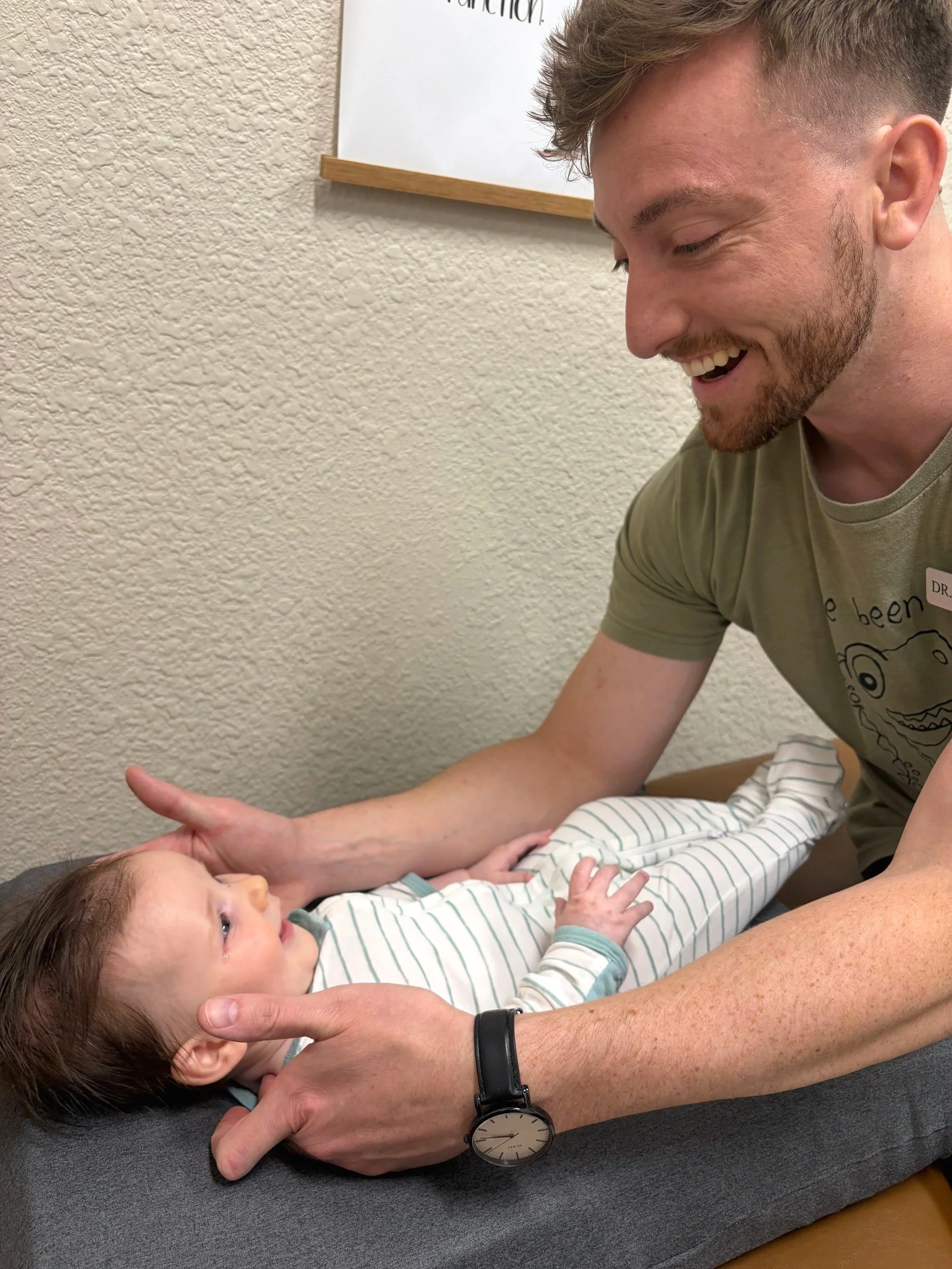
During her son's very first adjustment with Dr. Carson, this mom watched something she didn't expect.
"During that very first adjustment, I could literally watch the tension melt out of my baby in Dr. Carson's arms."
That night, her son took a two-hour nap. On his own. His latch improved almost immediately. He seemed calmer. Less fussy.
"I was basically sold after one visit," she wrote.
Seven weeks of twice-weekly adjustments later, here's where things stood:
• Latch: 100% better
• Gas: almost completely gone
• Mood: happy, content, smiley, and genuinely comfortable
• Naps: from 20 minutes held to 1–2+ hours independently
• Overnight sleep: stretches of 6, 7, sometimes 9+ hours
"This may sound strange, but he literally feels like a lighter baby in my arms because so much of his tension is gone."
"Babies Don't Know Placebo"
We know some of you reading this are skeptical. Maybe you've heard that pediatric chiropractic "isn't real," or that any improvement is just the baby growing out of it, or that it's all in the parents' heads.
This mom anticipated that skepticism. She addressed it herself:
"If you're hesitant, or if you've heard pediatric chiropractic 'isn't real,' all I can say is babies don't know placebo — and the changes we saw after that very first visit, and every visit since, speak for themselves."
A six-week-old cannot want to feel better badly enough to manufacture a two-hour independent nap. He cannot will his latch to improve. He cannot decide to stop being gassy. What changed was his nervous system — and the scans we performed before and after care show that objectively.
That's not anecdote. That's a measurable shift in how his body was functioning.
The Moment That Meant More Than She Could Put Into Words
The results are what brought this mom back. But the experience is what made her feel like she'd found her people.
She described walking in for the first time — exhausted, baby crying, trying to fill out paperwork — and Susie coming over and gently taking her son so she could get it done. She wrote that that moment alone "meant more than I can put into words."
She talked about Fabian greeting her and walking her through the history of chiropractic. About Dr. Carson's energy — "charismatic, funny, compassionate, caring — exactly what an exhausted mom needed." About the team remembering what's going on in their lives, celebrating wins, asking follow-up questions.
And then she shared something that humbled us:
"During a family emergency, they put my loved one on their prayer list and still ask about him every visit. That kind of genuine compassion is so rare in healthcare these days."
That's what we're here for. Not just the results — though we work hard for those too — but the whole family. The exhausted mom filling out paperwork with a crying baby in her arms. The dad who didn't know what else to try. The family that needed someone in their corner.
"This place didn't just help my baby… it helped my entire family. We are all thriving now."
Is Your Baby a "Velcro Baby" — Or Is Something Else Going On?
If your baby only sleeps in arms, struggles to latch, seems gassy and uncomfortable no matter what you try, or is just relentlessly fussy — please don't accept "this is just how some babies are" as the final answer.
Our neurological scans take the guesswork out of it entirely. We can show you, objectively, what is happening in your baby's nervous system — and whether care is the right next step.
Somebody's 'Velcro baby' is out there taking 9-hour sleep stretches. Come find out if yours can too.