"She Is Finally Finding Her Voice": What Happened When We Started Caring for a 6-Year-Old With Cerebral Palsy
Nylaa is non-verbal and uses a wheelchair. One month into care, she began communicating in full sentences. This past week, she vocalized and smiled for five straight minutes during and after her adjustment — while her parents stood at the edge, beaming, and said, "Tell us more, Nylaa."
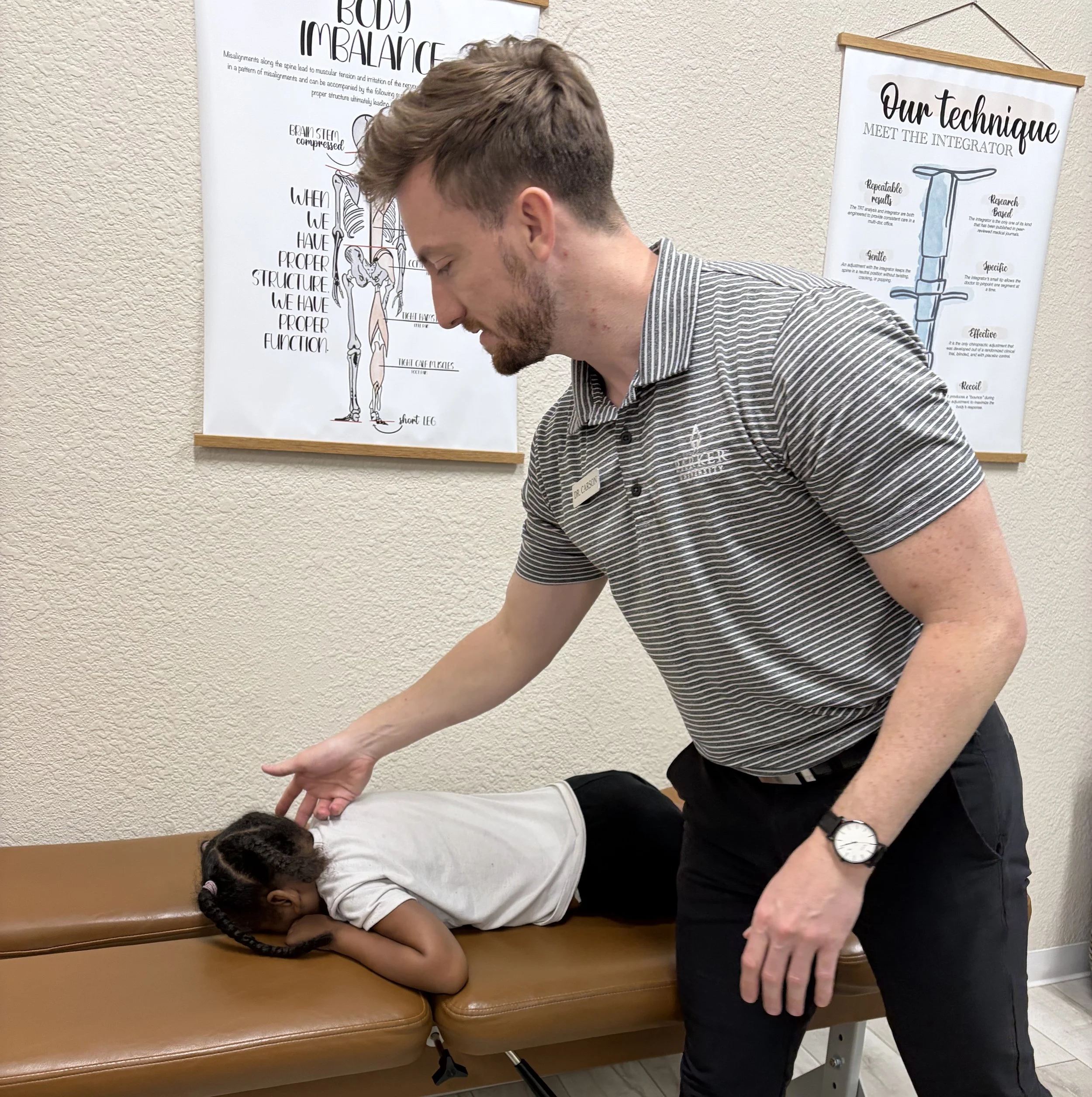
A note before we begin: We are not claiming that chiropractic care treats or cures cerebral palsy. What we are sharing is the experience of one family — in their own words — and what we witnessed in our office. Nylaa's parents have given their full permission for us to share her name and story. Our role in her life is one piece of a much larger care team, and we are honored to be any part of it at all.
Meet Nylaa
Nylaa is six years old. She has cerebral palsy. She is non-verbal and spends her life in a wheelchair. She communicates through an eye-tracking device — a specialized computer that follows her eye movements and translates them into words and phrases on a screen.
Before she came to Edified, Nylaa communicated through that device using single words. Yes. No. The most basic building blocks of expression.
She has been coming to our office for about two months. And in that time, something has been shifting.
What Is Cerebral Palsy — And What Does It Have to Do With the Nervous System?
Cerebral palsy is a neurological condition caused by damage to or differences in the developing brain, most often occurring before, during, or shortly after birth. "Cerebral" refers to the brain; "palsy" refers to difficulties with movement and motor control. It is the most common motor disability in childhood.
CP affects each person differently. For some, it primarily impacts movement and muscle tone. For others, it affects speech, cognition, vision, or the ability to communicate. Many individuals with CP have a full, rich inner world — thoughts, feelings, preferences, humor, personality — that the condition makes difficult or impossible to express outwardly in conventional ways.
At its core, cerebral palsy is a nervous system condition. The brain's ability to send and receive signals — to coordinate movement, regulate tone, process sensation, and communicate — is affected. Which means that anything supporting nervous system function has the potential to matter.
That is the lens through which we approached Nylaa's care. Not as a treatment for cerebral palsy. But as support for a nervous system that has been working incredibly hard — and perhaps carrying more tension and interference than it needs to.
When the Nervous System Is in Survival Mode, the Brain Can't Do Its Best Work
Here's a piece of neuroscience that helps explain what we've been witnessing with Nylaa — and honestly, what we see across a wide range of patients, from anxious adults to fussy newborns.
The autonomic nervous system has two primary states: sympathetic (fight-or-flight) and parasympathetic (rest, digest, and connect). When the nervous system is chronically stuck in sympathetic overdrive — perceiving threat, managing stress, bracing against the world — it prioritizes survival above everything else.
That means the higher-order functions of the brain — the prefrontal cortex, the areas responsible for language, rational thought, emotional regulation, social connection, and communication — get suppressed. The brain is too busy managing perceived danger to invest resources in expression and connection.
Think of it this way: when your body believes it is running from a threat, it doesn't pause to have a conversation. It runs. The talking, the connecting, the thinking — those come after. They come when the nervous system feels safe.
For a child like Nylaa, whose nervous system has been under significant chronic stress — neurological, physical, and sensory — that fight-or-flight state can become the default. Not because of anything she or her family has done wrong. Simply because of the load her nervous system has been carrying.
When we use gentle, specific chiropractic adjustments to reduce the interference in the nervous system — to quiet some of that background noise and help the body feel safer — we create space. Space for the parasympathetic system to engage. Space for the higher brain to come online. Space for communication, connection, and expression to emerge.
We believe that is part of what we have been watching happen with Nylaa.
One Month In: Full Sentences
About a month into care, Nylaa's parents came in glowing.
They shared that Nylaa had become more communicative. When we asked them to expound, they told us that she had moved beyond yes and no on her eye-tracking device and had begun communicating in full sentences. Real phrases. Specific, meaningful expressions of her inner experience.
"I want to be held."
"I don't want to be touched."
Preferences. Boundaries. Self-expression. From a child who had previously communicated in single words.
Her parents were so excited they could barely contain it. We were too.
We want to be careful here: we cannot claim that chiropractic adjustments caused this shift. What we can say is that this is what her family observed, in this window of time after they had started care with our team. And we think that matters because previously, this type of communication hadn’t been happening.
"Tell Us More, Nylaa"
This past week, Nylaa came in for her adjustment with her whole family.
While she was on the table being adjusted, she did something that stopped everyone in the room.
She looked up. There was a grin on her face. She looked at mom. She looked at dad. And she started to vocalize.
Her parents came to the edge of the table. They leaned in. And they spoke to her the way parents do when they are witnessing something they have waited a long time to see:
"Tell us more, Nylaa."
"We want to hear you."
She vocalized and smiled for five minutes. Her parents shared that she has communicated vocally before, but never for this long. Never with this kind of sustained, joyful expression.
They also mentioned that Nylaa has previously had a very difficult time lifting her head when on her stomach. That day, on the table, she lifted it.
When the adjustment was over, she didn't stop. She continued to vocalize and smile for several minutes afterward — as though something that had been building finally had a way out.
Mom said that they feel like she is finally finding her voice.
We were honored just to be in the room.
"You Guys Are More Than Just a Part of It"
After that appointment, we thanked Nylaa's parents for allowing us to be part of her healing journey.
Her dad looked at us and said:
"You guys are more than just a part of it."
We will carry those words for a long time.
We are a chiropractic office. We are not Nylaa's neurologist, her occupational therapist, or her primary care physician. We are one piece of what we hope is a well-supported life for a little girl who has a lot to say and a family who desperately wants to hear her.
But if our piece — supporting her nervous system, reducing interference, helping her body feel a little safer — is giving her more access to herself? Then we will keep showing up for her every single week.
Who This Post Is For
If you are a parent of a child with cerebral palsy, a neurological condition, or any diagnosis that affects the nervous system — we want you to know that we see your child as a whole person. Not a diagnosis. Not a set of limitations. A person whose nervous system deserves the same care and attention as anyone else's.
We are not a replacement for any part of your child's existing care team. We would never suggest otherwise. But we may be a valuable addition — one that supports the nervous system at a foundational level and creates conditions where other therapies can work even better.
We use three non-invasive neurological scans — HRV, sEMG, and thermal imaging — to get an objective picture of how the nervous system is functioning before we ever begin care. No guesswork. No assumptions. Just data, and a plan built around your child specifically.
Nylaa has a lot to say. We think a lot of kids do. Sometimes the nervous system just needs a little help getting out of the way.