"I Never Would Have Imagined": What Nine Months of Care Looked Like for a 79-Year-Old Who Got Her Life Back
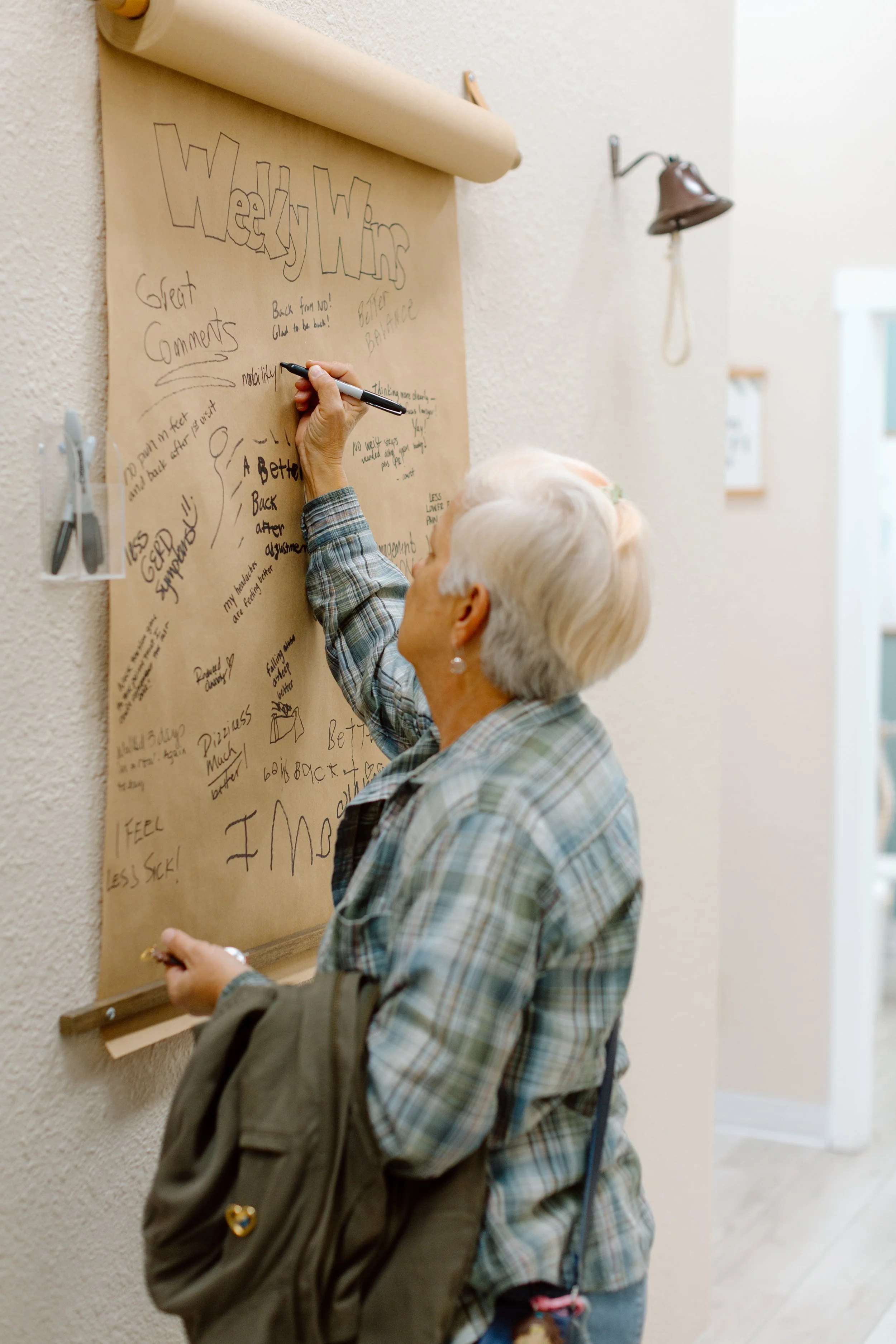
Ruth came in with daily leg numbness, neck pain, sleep problems, and unstable blood pressure. Nine months later, she was crawling around a jungle gym with her granddaughter — and realizing she never wanted to stop.
Meet Ruth
Ruth is 79 years old. She is one of the kindest, most quietly joyful people who has ever walked through our doors. When we share stories of other patients who have experienced change — the baby who slept through the night, the woman who drove herself for the first time in six years — Ruth tears up. She loves hearing about what the body is capable of when it gets the support it needs.
What she didn't know when she first came in was that her own story was about to become a miracle. She'll also be the first to tell you — she was skeptical. She didn't arrive at Edified a believer in chiropractic care. She arrived cautious, open-minded enough to try, but genuinely uncertain whether any of it would make a difference for her. Nine months later, she told us that we had turned a skeptic into a firm believer in what we do.
Nine months ago, Ruth came to Edified Chiropractic with a list of things that had been quietly diminishing her quality of life. Daily numbness running into her leg. Frequent neck pain. Sleep that wasn't restoring her. Blood pressure that had been unpredictable enough to require medication. On the surface, these might seem like separate problems. They are not.
They are all signals from the same nervous system — a nervous system that had been carrying a lifetime of accumulated load and was no longer able to regulate the way it was designed to.
One Nervous System. Many Symptoms. One Root Cause.
When patients come in with multiple seemingly unrelated symptoms, we often hear some version of: I have a lot going on. I know it's probably a lot to deal with. What they don't always know is that those symptoms frequently share a single origin — the nervous system.
Here's how each of Ruth's presenting concerns connects back to nervous system function:
• Leg numbness: The nerves that carry sensation and motor signals to the lower extremities travel through the lumbar spine. When there is compression, tension, or dysfunction in that region, numbness, tingling, or weakness in the legs is a common result. Daily numbness is the nervous system's way of signaling that something is interfering with those pathways.
• Neck pain: The cervical spine is one of the most neurologically significant regions of the body. Tension and restriction here doesn't just cause local pain — it can affect everything from headaches and sleep to blood pressure regulation and arm sensation, because of how densely the upper cervical region is connected to the brainstem and autonomic nervous system.
• Sleep difficulties: The autonomic nervous system governs the body's ability to shift into the parasympathetic state required for deep, restorative sleep. A nervous system stuck in chronic sympathetic activation — fight-or-flight — cannot downregulate effectively at night. Sleep becomes light, fragmented, or unrefreshing regardless of how many hours are spent in bed.
• Blood pressure: The autonomic nervous system plays a direct role in regulating cardiovascular function, including blood pressure. The upper cervical spine in particular has well-documented connections to blood pressure regulation. When nervous system function in that region is compromised, blood pressure can become harder for the body to self-regulate.
When we look at Ruth's symptoms through this lens, they stop being a complicated, multi-system puzzle. They become a single story about a nervous system that needed support. And that changes everything about the approach.
Nine Months Later: In Her Own Words
At Ruth's most recent re-evaluation, she shared what nine months of consistent care had looked like for her.
"Blood pressure is more steady, can stand longer and walking great, more ability to accomplish without a nap."
We want to sit with that last phrase for a moment: more ability to accomplish without a nap.
For someone in their late 70s, fatigue is often accepted as an inevitable part of aging. The afternoon nap becomes a necessity. The day gets shorter. The list of things that feel possible gets smaller. What Ruth is describing is that list getting longer again — that the energy available to her for living has increased because her nervous system is no longer spending so much of it managing dysfunction.
She also mentioned, quietly and on her own terms, that she has lessened her blood pressure medication. Not because anyone recommended it — that is a decision made with her doctor, as it always should be — but because her body simply hasn't felt like it needs as much. Her nervous system is regulating more effectively on its own.
A Wedding Reception, a Funeral, and Hours on Her Feet
Ruth shared a story from a recent weekend that stopped us in our tracks.
Within the same weekend, she attended a wedding reception and a funeral. Two significant events. Hours of standing, moving, being present, being on her feet in the way that life's most important moments require you to be.
By the end of the day, she realized something. She wasn't done. She had stamina she hadn't expected. The kind of endurance that, not long ago, would have required her to rest and recover for the better part of the next day. That weekend, she moved through both events and arrived at the end of it still standing — and surprised by herself.
For someone whose daily leg numbness had been limiting what she was willing to attempt, that kind of day represents something significant. It represents a nervous system that is communicating more clearly — muscles receiving their signals, circulation moving the way it should, the body doing what it was designed to do when interference is reduced.
The Jungle Gym
And then there was the jungle gym.
Ruth was playing with her granddaughter. And she found herself crawling around on a jungle gym — on her hands and knees, moving through the kind of play structure that belongs to children and the grandparents who love them enough to follow them in.
She told us afterward that she never would have imagined doing something like that before care. Not because she didn't want to. But because her body had simply not felt capable of it. The numbness. The neck pain. The fatigue that came with managing all of it. These things had quietly put a ceiling on what she thought was available to her.
Nine months of consistent care raised that ceiling.
She was on a jungle gym with her granddaughter. She was present. She was moving. She was there in a way she hadn't been able to be before — and she knew it.
"I never would have imagined doing that type of thing before care. But I've just been feeling so good."
That is what we are here for. Not just the absence of pain. The presence of life.
It Is Never Too Late to Support Your Nervous System
We want to speak directly to something Ruth's story challenges: the idea that at a certain age, decline is simply what happens. That the naps are inevitable. That the numbness is just something to manage. That the blood pressure will always need more medication, not less. That jungle gyms are for other people now.
We are not saying that aging doesn't bring real changes. It does. We are saying that a nervous system that has been carrying decades of accumulated stress — the falls, the injuries, the emotional seasons, the physical load of a long and full life — has often never been given the support it needed to function at its actual potential.
Ruth is 79. She started care nine months ago. And she is crawling around jungle gyms and standing through weddings and funerals and waking up with more in the tank than she used to have by noon. That is not in spite of her age. That is what happens when the nervous system gets what it needs — at any age.
Our three non-invasive neurological scans — HRV, sEMG, and thermal imaging — give us an objective picture of how the nervous system is functioning regardless of age. We see patients from newborns to patients well into their 80s, and the same principle applies across all of them: when interference is reduced and the nervous system can communicate clearly, the body does remarkable things.
Ruth tears up in our office when she hears other people's healing stories. We hope someone reads hers and feels the same way.