The Eye Doctor Who Changed His Mind: How Peggy's Adjustments Started Doing Something Nobody Expected
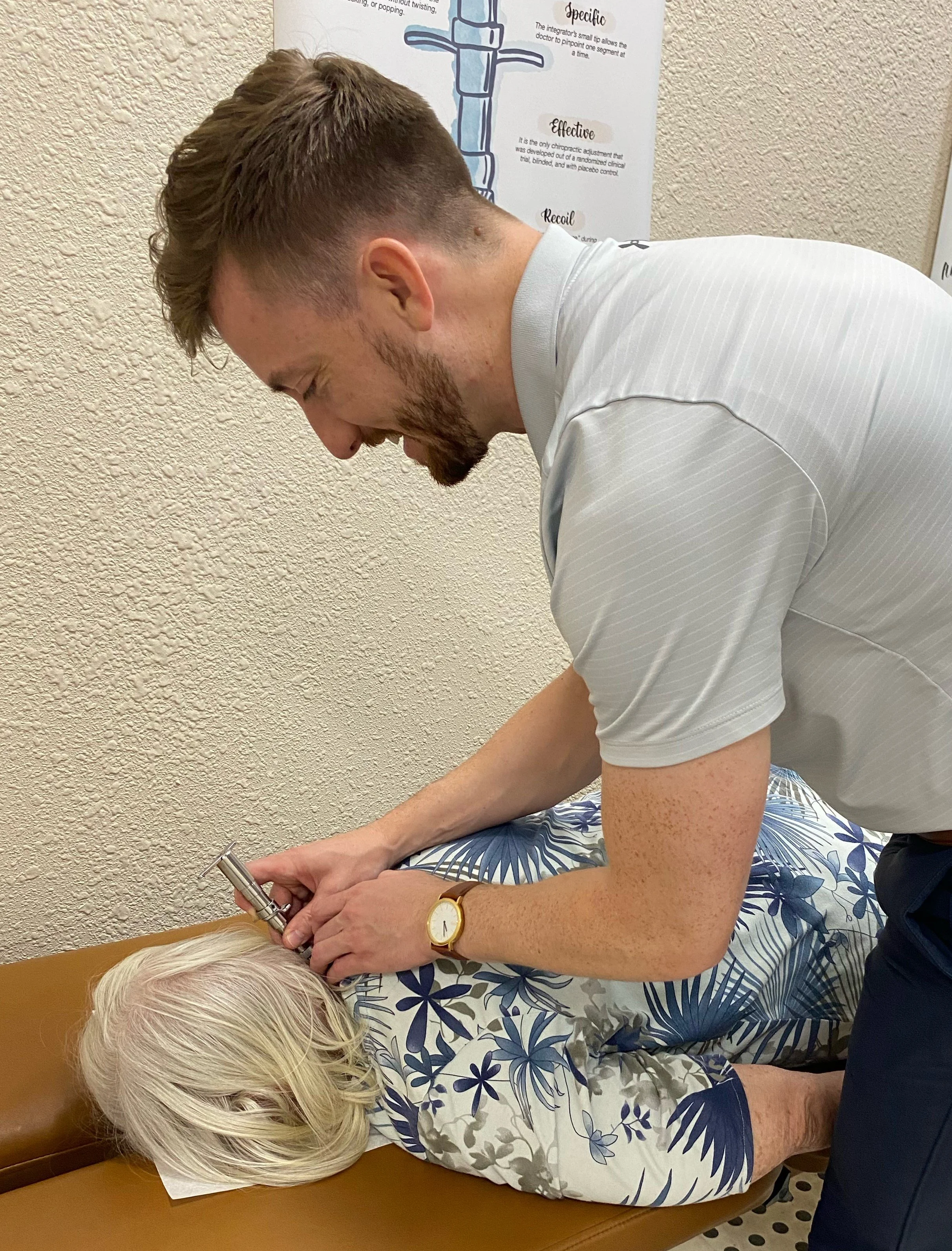
Peggy came to us because her family was considering a wheelchair. Eight months later, her eye doctor — who had initially shrugged off chiropractic — told her family there may be a correlation between her adjustments and the reduction of inflammation in her eye. And her doctor’s own scans show it.
A note before we begin: We are not claiming that chiropractic care treats or cures macular degeneration. What we are sharing is the experience of one patient and family — and the observations of her own eye doctor over time. The science we present here is our best explanation of a mechanism we find compelling — and that her eye doctor has now acknowledged.
What Does the Nervous System Have to Do With Inflammation?
Most people think of chiropractic care as something for the back and neck. And while we do adjust along the spine, we are more intentional with what those bones actually protect: the nervous system.
The nervous system doesn't just control movement and sensation. It regulates virtually every function in the body — including the immune system and the body's inflammatory response. This is a well-established area of research sometimes called neuroimmunomodulation: the study of how the nervous system influences immune function.
Here's the short version: when the nervous system is under chronic stress — whether from physical tension in the spine, emotional load, or accumulated dysfunction over time — it can push the body toward a state of chronic, low-grade inflammation. The autonomic nervous system, specifically the sympathetic branch, is pro-inflammatory when chronically activated. The parasympathetic branch, by contrast, has a natural anti-inflammatory effect.
When we use specific chiropractic adjustments to reduce interference in the nervous system — to help the body shift out of sympathetic overdrive and into a more balanced, parasympathetic state — we are, in effect, supporting the body's own ability to regulate inflammation. Not through medication. Not through a targeted treatment aimed at any specific organ or condition. Through the nervous system itself.
That's the mechanism behind Peggy’s story. And it's why her eye doctor's observation — puzzling at first — eventually made sense.
Meet Peggy
Peggy is in her 80s. She has macular degeneration — a condition affecting the central part of the retina — and has been managing it with monthly injections into her eyes for over eight years. Those injections help keep inflammation at bay and slow the progression of the disease. They are not a cure. They are maintenance, required month after month, year after year.
When her family first brought her to Edified Chiropractic, the eyes weren't the focus. Peggy's back pain had become severe enough that her family was seriously considering a wheelchair for her. That was the immediate concern — her mobility, her quality of life, her ability to move through her days with any degree of independence.
We started caring for her nervous system. And within a couple of months, something her eye doctor hadn't expected began to happen.
The Eye Doctor Who Didn't Expect to Be Surprised
A few months into Peggy's care, her eye doctor started noticing that the inflammation in her eye was reducing. Not a dramatic drop — but a measurable, consistent trend in the right direction. Enough to catch his attention.
He asked Peggy's daughter if anything had changed. Had she started a new medication? Changed her diet? Was she doing anything differently?
Her daughter mentioned that Peggy had started seeing a chiropractor.
He shrugged it off, not seeing how that could positively impact her eyes.
But the inflammation kept reducing. Month after month, the trend continued. And then something happened that made the pattern undeniable.
The Trip That Changed the Conversation
After nine months of consistent care, Peggy traveled out of state for several weeks. She wasn't able to come in for her adjustments during that time.
When she returned home and went to her next eye appointment, the inflammation in her eye had started to rise again.
She came back to our office and resumed her regular adjustment schedule.
One month later, the inflammation was back down to where it had been before her trip!
That sequence — inflammation reducing with care, rising without it, and coming back down when care resumed — is what researchers call a dose-response relationship. It's one of the strongest indicators that two things are actually connected, not just coincidentally occurring at the same time. Her eye doctor couldn't ignore it any longer.
He told Peggy's family that there is a correlation between her adjustments and the impact on inflammation in her eye. He went further: saying that her adjustments appear to be helping prevent the macular degeneration from advancing to her other eye.
The same doctor who had shrugged off chiropractic was now acknowledging what the pattern had made impossible to dismiss and recommended she continue her care with us.
And the Wheelchair They Never Needed
In the midst of all of this, something else was happening that's easy to overlook: the reason Peggy came to us in the first place.
Her family had been considering a wheelchair. Her back pain was that significant. Today, she is not in a wheelchair. Her back still bothers her — we won't overstate it — but the trajectory has changed enough that a wheelchair hasn’t been a part of her life. For a woman in her 80s with severe back pain, that is not a small thing. That is her continued ability to move through the world on her own terms.
This is what we mean when we talk about caring for the whole person. We didn't start her care promising Peggy's eyes would improve. We didn't come in targeting her back pain as an isolated problem. We supported her nervous system — and her nervous system, given that support, began doing what nervous systems do when interference is reduced: it started regulating better. Her spine. Her pain signals. Her inflammatory response. Her eyes.
One nervous system. Many downstream effects.
It's Never Too Late to Support Your Nervous System
Peggy's story is a reminder that chiropractic care is not just for people with back pain, not just for young athletes, and not just for babies and pregnant moms — though we love caring for all of them. It is for anyone with a nervous system that is carrying more load than it should.
If you have an aging parent whose health has been declining, whose pain has been increasing, or whose doctors keep managing symptoms without addressing root causes — a neurological assessment may be one of the most valuable things you can offer them. We use three non-invasive scans — HRV, sEMG, and thermal imaging — to get an objective picture of how the nervous system is functioning, regardless of age or condition.
We didn't set out to help Peggy's eyes. Her nervous system had other plans.