"I Drove Myself": How Jennifer Got Her Life Back After Six Years of Constant Vertigo
For six years, Jennifer couldn't drive, couldn't sleep on her back, and couldn't escape the dizziness that had taken over her life. This week, she walked into our office alone. When we asked where her husband was, she said she had driven herself.
Six Years
That's how long Jennifer lived with constant vertigo before she walked through our doors.
Not occasional dizziness. Not a vertigo episode here and there. Constant. Six years of her world spinning, shifting, and refusing to stay still. Six years of not being able to drive herself anywhere. Six years of not being able to lie flat on her back to sleep. Six years of her husband accompanying her to appointments, errands, and anywhere life required her to go.
Vertigo at that level doesn't just affect your balance. It affects your identity. Your independence. The quiet confidence of being able to move through the world on your own terms. Jennifer had lost all of that — and she had been living without it long enough to start wondering if she’d ever get it back.
Then she came to Edified.
What Vertigo Actually Is — And Why the Nervous System Is at the Center of It
Vertigo is the sensation that you or the world around you is spinning or moving when it isn't. It's not the same as general dizziness or lightheadedness, though those often come with it. True vertigo involves a disruption in the body's ability to accurately process spatial orientation — to know where you are in relation to the world around you.
That processing happens through three systems working in concert: the inner ear, the eyes, and the nervous system — specifically the signals traveling through the upper cervical spine to the brainstem. The brainstem is the relay station for all of that spatial information. When the signals coming through are distorted or disrupted, the brain receives conflicting information about where the body is in space. The result is vertigo.
This is why tension, restriction, or misalignment in the upper cervical spine can be a significant driver of chronic vertigo — even when imaging and specialist visits don't turn up an obvious cause. The problem isn't always structural. Often, it's communicative. The nervous system isn't receiving clean, accurate signals, and the body is doing its best to interpret a distorted picture.
Neurologically-based chiropractic care addresses exactly that. By reducing interference in the nervous system — particularly at the upper cervical level — we help restore the accuracy of those signals and give the brainstem what it needs to recalibrate.
For Jennifer, a year of that recalibration changed everything.
Every Adjustment, She Got Dizzy. That Was Actually a Good Sign.
We want to share something about Jennifer's care that might seem counterintuitive at first — because we think it's important to hear for anyone considering coming in with a similar condition.
After every adjustment, when Jennifer sat up from the table, she experienced a dizzy spell. Every single time — about three minutes of dizziness while her nervous system adjusted to the change. We stayed with her, helped stabilize her, and waited with her while she got her balance back.
But here's what we were watching happen: each time, the recovery got a little faster. Three minutes became two. Two became one. The dizzy spell that used to linger started to lift more quickly. And eventually — after consistent care — Jennifer could hop up off the table without any dizziness at all.
That progression wasn't a setback. It was the nervous system recalibrating in real time. When a system that has been dysregulated for six years starts receiving new, accurate input, there is an adjustment period. The brain has to update its picture of the world. That process can feel like disruption before it feels like relief.
This is one of the most important things we want patients to understand about nervous system care: healing isn't always linear. Sometimes the body has to move through something before it comes out the other side. Jennifer moved through it — every single week — and she kept showing up.
Eight Months In: "I Haven't Felt a Ton of Change — But My Husband Has Seen So Many"
At six months, Jennifer was honest with us. She told us she hadn't felt a ton of change herself — but that her husband had been noticing shifts in his own health with care. She held onto that. She kept telling herself that it had to be helping her nervous system because it was helping him.
That kind of trust — in the process, in the data, in the people around her — is one of the most courageous things a practice member can do. And it's exactly the kind of commitment that allows deep, lasting change to happen.
Two months later, at eight months into her care, Jennifer came into the office beaming.
She had just gone four days without vertigo. Four consecutive days, vertigo free — for the first time in six years.
We celebrated that with her.
Within the next couple of weeks, she came back with something even bigger. She told us she was ready to acknowledge something she hadn't been able to say before:
"I'm experiencing moments of vertigo rather than days."
Moments. Not days. Not weeks. Moments.
From six years of constant vertigo to moments. That sentence is worth sitting with.
"Where's Your Husband?" "I Drove Myself."
This week, Jennifer walked into our office by herself.
We noticed right away. We asked where her husband was.
She smiled and told us she had driven herself.
For six years, Jennifer hadn't been able to get behind the wheel. For six years, her independence had been on hold, her husband her constant companion out of necessity rather than just choice. And in a year of consistent care — she got it back.
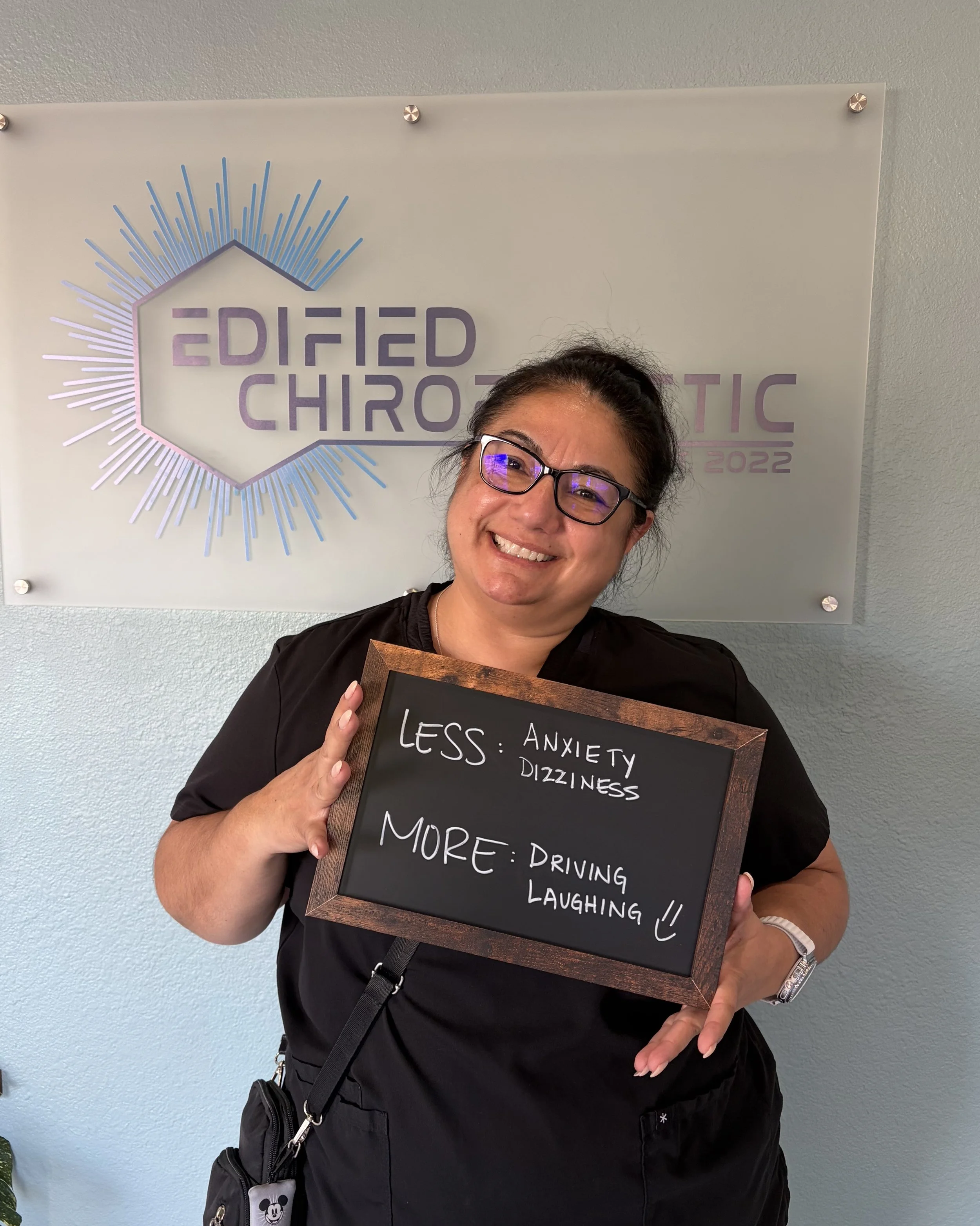
Her chalkboard sign captures it better than we ever could:
Less: anxiety + dizziness
More: driving + laughing
That's what a year of consistent nervous system care can look like.
If Vertigo Has Been Running Your Life, You Don't Have to Keep Waiting
Chronic vertigo is one of the most disorienting — in every sense of the word — conditions a person can live with. It affects everything: sleep, driving, working, being present with people you love. And because it often doesn't show up on scans or tests, it can feel like nobody has a real answer for you.
We don't promise Jennifer's results for every patient. Every nervous system is different, and every case has its own timeline. What we do promise is an objective look at what's happening in your nervous system — through our three non-invasive scans: HRV, sEMG, and thermal imaging — and a plan built specifically around what we find.
We serve families and individuals across Gilbert, Mesa, Chandler, Queen Creek, San Tan Valley, and the greater East Valley.
Six years is a long time to wait. You don't have to wait any longer.